
What We Mean by Levels of Evidence
 Professor PepBuddies
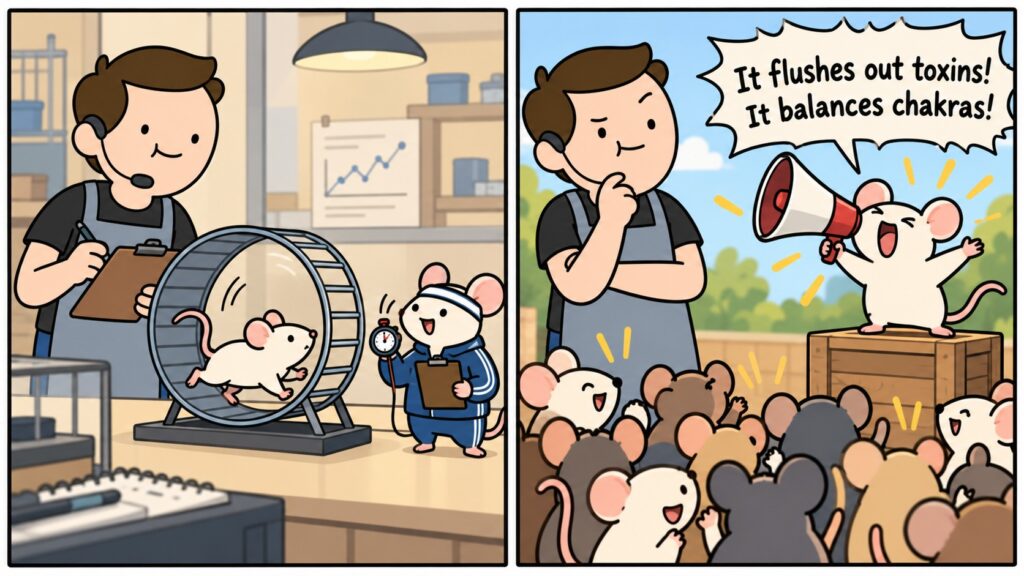
When we talk about peptide research, one phrase is going to appear frequently on this site: "What is the evidence?"
That sounds like a simple question, but it isn't. Evidence exists on a spectrum. A biological mechanism observed in a laboratory, an experiment in mice, a randomized human trial, and thousands of people reporting similar experiences online are all forms of information.
They are not, however, equivalent forms of evidence.
Understanding that is important, because peptide discussions have an unusual tendency to mix them together.
A compound may have a compelling mechanism, impressive animal research, and enthusiastic reports from people using it, while having almost no controlled human evidence at all. Another compound may have completed several large Phase 3 clinical trials involving thousands of participants. Calling both compounds "research-backed" would technically be possible, but it would hide an enormous difference in what we actually know.
So when we discuss evidence on this site, this is roughly how we think about it.
MECHANISTIC EVIDENCE
Mechanistic evidence can tell us why something might work. Researchers identify a receptor, signalling pathway, protein, hormone, or other biological process and find that a compound interacts with it.
This is usually where the story begins.
For example, if a peptide activates a receptor known to influence appetite, inflammation, tissue repair, or glucose metabolism, researchers have a plausible reason to investigate whether changing that pathway produces a useful effect. This kind of research is extremely important.
It is also extremely easy to overinterpret.
Biology contains enormous numbers of interconnected systems. Changing one pathway in a test tube does not automatically produce the expected result in an entire human being. A plausible mechanism therefore means "there is a scientifically interesting reason to investigate this", but it does not mean "we have demonstrated that this produces a useful clinical effect".
CELL AND LABORATORY RESEARCH
The next layer often involves cells, tissues, or other laboratory models.
Researchers may expose particular cells to a compound and observe changes in growth, signalling, inflammatory markers, gene expression, or other measurable processes. These experiments allow scientists to explore mechanisms much more precisely than would be possible in a living person, and they can provide strong evidence that a biological interaction is real... but cells in a laboratory are not people.
A compound that produces an impressive effect when placed directly onto cultured cells may be metabolized, degraded, distributed differently, or never reach the relevant tissue when introduced into a living organism. Laboratory evidence can therefore strengthen a hypothesis without demonstrating that the same outcome will occur in humans.
ANIMAL STUDIES
Animal research moves the investigation into a complete biological system. Researchers can examine metabolism, organ effects, behaviour, toxicity, pharmacokinetics, and many other variables that cannot be meaningfully reproduced in a dish. This is a major step forward. It is still not human evidence.
Mice are not miniature humans.
(Neither are rats, monkeys, pigs, or other research animals.)
Many biological systems are similar enough that animal studies can provide tremendously useful information. Others differ in ways that only become obvious once researchers begin human trials. An animal study showing that a peptide improves wound healing, reduces inflammation, preserves muscle, or alters metabolism may provide a good reason to investigate that effect in humans. It does not demonstrate that the same effect occurs in humans.
OBSERVATIONAL HUMAN EVIDENCE
Things become considerably more interesting once people enter the picture.
Observational research examines what happens to people without researchers necessarily assigning a particular intervention. This might involve medical records, registries, surveys, long-term population studies, or groups of people already using a particular treatment. The advantage is obvious: these are actual human outcomes.
The disadvantage is that real life is ... well, messy.
People differ in age, diet, activity, genetics, medications, health conditions, socioeconomic circumstances, and hundreds of other variables. If people using a particular compound appear to experience an outcome more frequently, researchers must ask whether the compound actually caused it.
Observational research can identify powerful associations, but it generally has more difficulty establishing causation.
CASE REPORTS AND CASE SERIES
Sometimes something unusual happens to one person, or a small group of people, and clinicians document it. These reports can be extremely valuable. Many important medical discoveries and safety signals began this way. But a case report cannot tell us how commonly an outcome occurs, whether the compound caused it, or whether other factors explain what happened.
Think of case reports as signals, they tell researchers: "This happened, and it may be worth investigating".
They rarely tell us: "This will generally happen".
PHASE 1 CLINICAL TRIALS
Clinical development usually begins with relatively small human studies.
According to the U.S. Food and Drug Administration, Phase 1 studies commonly involve roughly 20 to 80 participants and concentrate heavily on pharmacology, metabolism, dose-related effects, and safety.
This is where researchers begin answering questions such as:
- What happens to the compound inside the human body?
- How long does it remain there?
- What effects appear at different exposures?
- What adverse effects emerge?
Phase 1 can sometimes provide hints about efficacy, but it normally is not designed to establish whether a treatment works reliably.
PHASE 2 CLINICAL TRIALS
Phase 2 begins asking a more direct question: "Does this appear to work?"
These studies commonly involve hundreds rather than just dozens of participants. At this stage, researchers can compare doses, identify common adverse effects, refine treatment protocols, and gather preliminary evidence of effectiveness. A successful Phase 2 result can be extremely encouraging, but it is still preliminary. Small studies can exaggerate treatment effects. Uncommon adverse events may not appear. Particular participant populations may respond differently from the broader population.
Phase 2 tells us that something appears promising enough to test properly.
PHASE 3 CLINICAL TRIALS
Phase 3 is where evidence becomes substantially more persuasive. These studies commonly involve hundreds or even thousands of participants and are designed to provide the efficacy and safety information needed to evaluate the overall benefit-risk relationship of a treatment.
There are several elements of Phase 3 trials that are important to know about:
- Randomization helps distribute participant differences between groups, control groups provide a reference against which outcomes can be compared.
- Blinding can reduce the influence of expectations from participants and investigators.
- Larger sample sizes make results more statistically reliable and allow less common adverse events to emerge.
A well-designed, replicated Phase 3 program represents considerably stronger evidence than a successful animal experiment or small uncontrolled human study, though it still is not perfect evidence.
Clinical trials also have what is known as inclusion criteria. Participants receive structured follow-up. Treatment adherence may differ from ordinary life. Some adverse effects only become apparent after much larger numbers of people use a treatment for longer periods.
That leads to another important category...
POST-MARKETING AND REAL-WORLD EVIDENCE
Approval does not mark the end of research. Rather, it marks the beginning of exposure on a completely different scale.
Once hundreds of thousands or millions of people begin using a medication, researchers can identify rare adverse events, investigate long-term outcomes, compare treatments in ordinary clinical practice, and study populations that were poorly represented in the original trials. A treatment can therefore have strong clinical-trial evidence while important questions remain unanswered.
THE TOP OF THE PYRAMID ISN'T A SINGLE STUDY
People often describe the "hierarchy of evidence" as though each study simply receives a rank, but reality is more complicated than that:
- One excellent randomized trial can be more informative than several poorly designed trials.
- A systematic review is only as reliable as the research it includes.
- Ten studies suffering from the same bias do not necessarily become convincing simply because there are ten of them.
Replication matters. Study design matters. Sample size matters. The population being studied matters. The endpoint matters.
Who funded the research matters as something to consider, although industry funding by itself does not invalidate a study. The actual methods and results still matter most.
WHERE DO COMMUNITY REPORTS FIT?
This is where peptide research becomes particularly interesting: large online communities now generate enormous amounts of anecdotal information. People discuss compounds, side effects, subjective effects, dosing patterns, combinations, unexpected outcomes, and experiences that may never appear in formal literature.
We think that information is worth examining, but we do not think it should be mistaken for controlled evidence.
Community reports suffer from several enormous limitations:
- There may be no placebo group.
- People know what they took.
- Product identity and purity may be uncertain.
- People who experience unusual results may be more likely to post about them.
- People may simultaneously change diet, exercise, medications, supplements, or other compounds.
- Outcomes are rarely measured consistently.
- People disappear from communities without explaining why.
- And sometimes widely repeated "common knowledge" ultimately traces back to a single forum post that everyone else simply repeated.
That makes community evidence unreliable for determining whether something works, but it can nevertheless be extremely useful for discovering what questions researchers might want to ask. If hundreds of unrelated people independently describe a similar unexpected effect, that does not prove the effect exists. It does create an interesting signal.
The contrast between evidence and community anecdotes is central to how we intend to approach community information on this site.
WHAT WE WILL TRY TO TELL YOU
Whenever possible, our articles will distinguish between:
- What has been demonstrated.
- What has been observed.
- What researchers suspect.
- What makes biological sense but remains unproven.
- What communities commonly report.
- And what nobody actually knows yet.
Those categories will sometimes overlap. They should never be silently substituted for one another.
"Interesting" does not mean "proven."
"Promising" does not mean "effective."
"People are doing this" does not mean "people should do this."
And "there is no clinical evidence" does not necessarily mean "this cannot work", it means exactly what it says: the clinical evidence does not yet exist.
That may be less exciting than declaring everything either miraculous or useless, but it is also considerably more useful.
\ Get the latest news /